Friday, September 26, 2008

Guinness in the morning

This week I've been working at the Guinness Storehouse in Dublin.

To get there, I take the DART train and then the Luas light rail. Here are a couple of Luas trains in the early-morning Dublin fog:


The Luas goes right past Guinness:


In early morning, walking through streets that haven't changed since Victorian times, the Guinness complex is very atmospheric. Part Charles Dickens and part Charley and the Chocolate Factory. Tall chimneys blowing steam, huge warehouses behind gates, and enormous vats.


Here we see one of street gates:


And here is an iconic Guinness gate:

Wednesday, September 24, 2008

Morning train commute in Dublin

When I'm in Dublin, I commute from Bayside into central Dublin to my company's offices there.

I take the DART train from Bayside (Cois Bá in Irish, which of course means "bay side"):


A return ticket costs 3 euro and 80 cents. That's well over 5 dollars for two 30 minute train trips. Over three times the price of the equivalent trip in Boston, although the trains are arguably cleaner and more comfortable.

I missed a train and have to wait 14 minutes for the next one:


Here comes the train:


As in Boston, there are free newspapers on the train. Here in Dublin there is the Metro and the Herald. Unlike Boston, the free papers in Dublin have full-page advertisements in Polish and Cantonese, but no Spanish.

Tuesday, September 23, 2008

Harvest Time

On Sunday we harvested the barley on the farm in Ireland. It was a nice sunny day. Here is a photo prior to the combine harvester doing its work:


Here is the combine harvester:


And here, in the distance, you can see the combine harvester emptying barley into a trailer.

Monday, September 22, 2008

Postscript: Tyrone Wins

Postscript to my post on the Red Hands on Friday: Tyrone beat Kerry in the big game yesterday.

The game was close, but Tyrone nosed ahead with a gold just after half time and then won it. As the Tyrone manager, Mickey Harte, said: "When you win, you don't do everything right and when you lose, you don't do everything wrong, but we did enough right today to get by."

I saw some straggling Tyrone fans this morning at 7am on O'Connell Street. Maybe they were starting to feel chilly in their Tyrone shirts, but they looked happy.

Friday, September 19, 2008

Red Handed

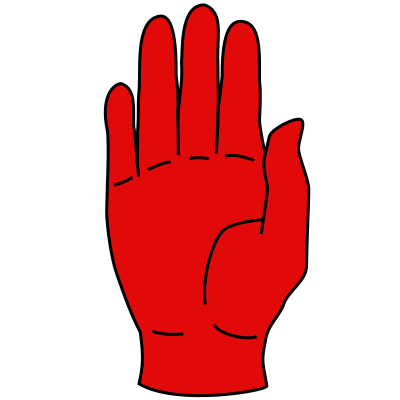
Tyrone play Kerry in the All Ireland Football Final this Sunday [note to US readers: Gaelic Football, not soccer]. The emblem of Tyrone is the red hand, so you would see many red hand flags around Tyrone (although not in government car parks, as this story sadly proves). There will be many red hand flags in Dublin too, where the game will be held on Sunday. I will be in Dublin on Sunday, but not at the game. Even though Croke Park seats around 85,000 , tickets are almost impossible to come by for this game.

[ Here is a large Tyrone red hand image courtesy of Wikipedia ]


As well as being the symbol of Tyrone, the red hand is also the emblem of Ulster, where it is one of the few symbols which is embraced by both sides of the religious divide. The red hand is also the symbol of the O'Neill family.

Where does the red hand come from?

The most common story is that at http://flagspot.net/flags/gb-ni-ty.html, concerning "the war between two kings for Ulster. The kings had decided that too many had died and a peaceful solution was to have a sea race as both were fond of this sport. As the race was coming to a close the King of Tyrone, O Neill saw he was loosing and thinking of the rules, first person to put a hand on the shore would be king, he cut off his hand and threw it to the shore giving rise to the legend of the red hand of Ulster and of Tyrone. The Tyrone county name comes from the Irish Tir Eoghain which translates to Eoghain county after Eoghain O Neill, the great king of Ulster.

Slightly different version on Wikipedia:
A variant famous myth recounts how Ó Neill and a man named Dermott both wished to be king of Ulster. The High King of Ireland suggested a horse race across the land. As the two came in sight of the ending point, it seemed that Dermott would win, so Ó Neill cut his hand off and threw it. It reached the goal ahead of Dermott's horse, winning for Ó Neill the crown of Ulster. The Gaelic war cry Lámh Dhearg Abu (Irish meaning- Red Hand to Victory) was forever associated with the O'Neills through the centuries.

Thursday, September 18, 2008

Property Management company behind Boston's Columbia Point to build and manage developments in Dublin?

I'd heard this discussed in Dublin a few months back, and today I see it mentioned in the Irish Times:

"COLUMBIA POINT used to be one of the worst slums in North America. Despite its beautiful location on Boston Harbour, not far from the Kennedy Library, it was wracked by every imaginable social problem, mostly drug-related. It was a ghetto, physically isolated from the city, a place nobody wanted to go.

Mostly boarded up when developers Corcoran Mullins Jennison (CMJ) arrived on the scene in 1987, it became the first federal housing project in the United States to be converted to mixed-income housing.

And with the end-result winning several awards, it has served as an exemplary model for similar schemes elsewhere."
http://www.irishtimes.com/newspaper/property/2008/0918/1221599462240.html


Corcoran Mullins Jennison now are in the frame to also provide property development and property management for Dublin Corporation and Fingal (north Dublin) Council.

The anecdotal angle I heard in Dublin was that CMJ are seen as being tough, no-nonsense, efficient operators who would enforce control on public housing developments in a way which is not now taking place in Dublin. The Irish Times piece does allude to this, but in a nice way, talking about how people must be interviewed to get places at the housing developments, and so on.

I hope they get the contracts. Some problem developments in Dublin could do with being remodeled along the lines of Columbia Point.

Wednesday, September 17, 2008

Girl Talk coming to Foxborough (but catch the New York show instead)

Girl Talk (AKA Gregg Gillis) sounds like what mash-ups are supposed to sound like. A single song blends Salt-n-Pepa, Nine Inch Nails, 50 Cent, and about 20 other artists. This makes for an uneasy relationship with copyright law, but for great music. The songs are mixed live on-stage using Audiomulch on a laptop covered in Saran Wrap.

Any performer who arrives on-stage to an ecstatic reaction while dressed in a suit and carrying a laptop is OK in my book.

- New Yorker Profile (scroll down a bit if you don't want to read the whole thing)
- "Pay what you want" album for sale as MP3s via Paypal off his MySpace page
- Wired Magazine's visual analysis of a single Girl Talk track which contains 35 samples

He plays Foxborough in November, but it's sold out. However, shhh, there are tickets available for an extra New York date at Terminal 5.

Girl Talk at Terminal 5 in New York has "Gig of the year" written all over it.

Tuesday, September 16, 2008

A hornets' nest

Spotted at the weekend in the Arnold Arboretum


Monday, September 15, 2008

Where in Boston?

A tunnel, a castle, a drop-down window, an onion-domed church in suburbia, a train yard.

Answers at the bottom of this post.


...


...


...


Answers:

1) Franklin Park. This tunnel runs under the road which runs past the golf course, close to the Forest Hills entrance.
2) This is a former armory which is now the Boston Smith and Wollensky's restaurant, near the Park Plaza hotel
3) ICA (Institute of Contemporary Art: http://www.icaboston.org)
4) Church on South Street, Roslindale. Near Fallon Field
5) Bay State Model Railroad, again in Roslindale.

Sunday, September 14, 2008

Roslindale Farmers Market

A great little farmers market every Saturday until 2pm. As well as the fruit and veg, there are also people selling free-trade coffee and chocolate, cheeses, flowers and plants. And, as the sign below says, the best tomatoes in Massachusetts.


Saturday, September 13, 2008

Friday, September 12, 2008

The Children of Lir

Last night I read my son the story of the Children of Lir , an old Irish legend in which four children are turned into swans. It struck me how sad the story is. The children are turned into swans against their will, their father dies, they spend 900 years in miserable conditions, then they all die. I could not see the story turning up as one of the stories Steve reads on Blues Clues. Many old Irish stories are sad like that.

We learned the story at primary (elementary school). I was interested in the story as a child, and when I read it again last night, new meanings strike me. Lir's new wife had said the four children were drowned in the lake, but Lir did not believe her. He went down to the lake where he saw four swans who he believed were his children. He spent the rest of his life living down by the lake with those four swans, and people came to help him and also to watch out of curiosity. As an adult now, I wonder was Lir just compensating for the loss of his children, who were actually drowned.

The lake is Lough Derravaragh. Derravaragh is Irish for "Lake of the Oaks", or "Lake of the oak groves". Doire means Oak, hence Derry in Ireland, and hence Derry in New Hampshire.

I grew up about 8 miles from Lough Derravaragh, so the story was local for me. The story was set a long time ago, but the site of Lir's castle is said locally to be the present site of Tullynally Castle, again a place familiar to me too.

Given that the story was taught by my teacher in primary school, and part of it was set locally, it seemed quite "real" to me.

Here is a page of the story, taken from the excellent Irish Fairy Tales book by Una Leavy and Susan Field:


The hill which Aoife walks up, beside Lough Derravaragh, is Knockeon (in Irish: Cnoc Eoghain, hill of Eoghan or Eyon).

Here is a photo I took of the shores of Lough Derravaragh, showing Knockeon sloping up on the right. This is where the children would have been turned into swans. I had been here with my son, and it was good to explain the site of the story to him as a place we had visited:

28052006

When I travel up to lakes in Maine and New Hampshire, I often think that they are similar to Lough Derravaragh or many other lakes in the Irish midlands. But, in Ireland there is much less pleasure boating and much less development around the lakes. For many lakes, pleasure boating is forbidden by law, and you would not get planning permission to build the kinds of lakeside houses which are common in New Hampshire or Maine. So the lake is as it was in the time of Lir.

Crookedwood is the closest town to that part of Lough Derravaragh. Here is a picture of Lough Derravaragh from the Crookedwood road. You can see more of the shore and hill here, as well as the oak trees which give the lake its name:

Lough Derravaragh from the Crookedwood road

And here is the same landscape in, uh, landscape:

17092006(003)

At a pull-off on the Crookedwood road, there is a poster explaining the story of the Children of Lir. I have photographed it in three pieces and pasted them below:


As the story above says, after 300 years at Lough Derravaragh they moved on to other locations around Ireland. I suspect that the reference to God was tacked onto the story when Christianity came to Ireland with Saint Patrick (many Irish stories have a Christian ending tacked on, such as the story of Tir na nOg).
If you visit Westmeath, or the Irish midlands in general, grab a copy of the Irish Fairy Tales book before you go, and then be sure to visit the site of the Children of Lir story.